Long-Term Health Effects Associated with Polyendocrine Metabolic Ovarian Syndrome (PMOS)
By: Noelle F. Di Perna
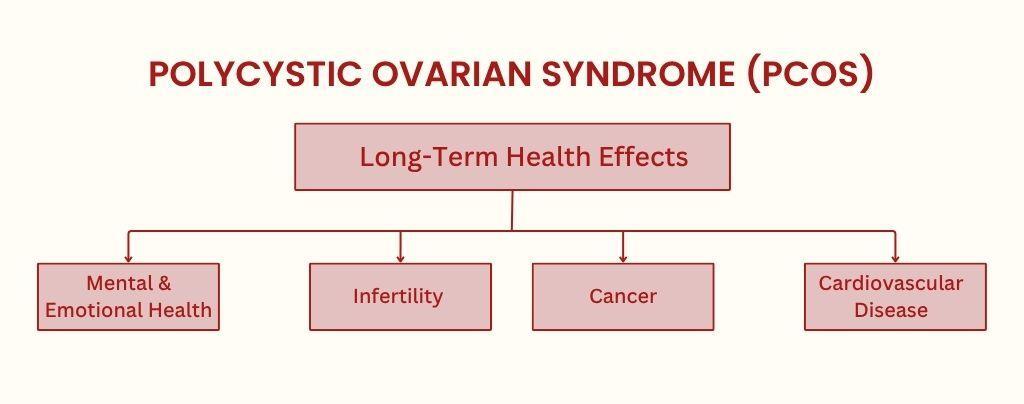
Introduction to PMOS
Polyendocrine Metabolic Ovarian Syndrome (PMOS) is a hormonal disorder affecting approximately 6-13% of reproductive-aged women around the world 1. While incredibly common, due to a lack of research and awareness surrounding this disorder, it is estimated that up to 70% of women with PMOS remain undiagnosed and searching for answers 1. With PMOS being so prevalent amongst the female population, it is crucial that at-risk women understand the current diagnostic criteria, symptoms, and long-term effects of PMOS to better advocate for their health and well-being in a healthcare system tainted with patriarchal practices. Furthermore, while there are known associations between PMOS and numerous long-term health conditions, the exact mechanism behind these associations is widely misunderstood and under-researched as a direct result of the prominent gender bias still existing in the contemporary healthcare system.
Cardiovascular Disorders
Epidemiologic studies over the last decade have revealed that PMOS, one of the most common hormonal disorders amongst reproductive-aged women, is associated with an increased prevalence of coronary artery disease (CAD) 2. This epidemiologic data inspired a recent study that investigated the cardiac tissue of PMOS mice, which revealed increased macrophage accumulation in the myocardium 2. Macrophage accumulation is largely associated with chronic inflammation in the heart, leading to CAD 2. These results were confirmed in women with diagnosed PMOS and control participants, validating the fact that while the exact mechanism is still unknown, PMOS is associated with an increased risk of developing cardiovascular disorders.
Cancer
Endometrial cancer is largely associated with PMOS. In fact, a recent systematic review showed that the development of endometrial cancer was 2.2 times higher in women with PMOS in comparison to the control group 3. In women without PMOS who experience a regular menstrual cycle, estrogen allows the uterine lining to grow, while progesterone prevents the uterine lining from growing in excess 3. However, women with PMOS typically do not have a regular menstrual cycle – resulting in decreased or no progesterone – allowing estrogen to stimulate the growth of the uterine lining without inhibition 3. Essentially, in women with PMOS the uterine lining is under constant growth stimulation, increasing the risk of endometrial cancer development.
Mental & Emotional Health
Both PMOS itself and the rigorous process associated with diagnosis and treatment of the condition are linked to worsening mental and emotional health 4. PMOS is largely tied to having hormonal imbalances with key hormones such as insulin, androgen, sex-hormone binding globulin (SHBG), and luteinizing hormones (LH) – contributing to increased risk of developing anxiety and depression 4. Additionally, struggles with receiving a diagnosis, living with a chronic condition, and battling the stigma associated with the condition contribute to heightened distress 4. This combination of physiological and societal factors plays a role in amplifying the risk of mental health disorders among women with PMOS.
Infertility
Despite the underlying physiological mechanism of PMOS being unknown, a key feature of the condition is an irregular menstrual cycle. While this does not occur in all cases, approximately 75-85% of women with PMOS will experience an irregular menstrual cycle 5. In the absence of a regular menstrual cycle, ovulation is unpredictable and sometimes unable to occur, resulting in numerous struggles when trying to get pregnant 5. Additionally, if affected women do conceive, the gestational period is often strenuous due to hormonal imbalances and comorbidities associated with PMOS 5. Even though fertility is challenging for affected women, through proper medical counselling and interventions, many are able to become pregnant and successfully give birth.
Summary
In summary, it is evident that PMOS is linked to numerous harmful long-term health conditions. Despite PMOS being widely misunderstood, knowledge is power. Through education of both PMOS and the conditions it can cause women everywhere, including you, are better equipped to advocate for themselves and their autonomy. That is what this is all about.
Bibliography
- World Health Organization. Polycystic ovary syndrome [Internet]. World Health Organization. 2025. Available from: https://www.who.int/news-room/fact-sheets/detail/polycystic-ovary-syndrome
- Gao L, Zhao Y, Wu H, Lin XH, Guo F, Liu J, et al. Polyendocrine Metabolic Ovarian Syndrome Fuels Cardiovascular Inflammation and Aggravates Ischemic Cardiac Injury. Circulation [Internet]. 2023 Dec 12;148(24):1958–73. Available from: https://www.ncbi.nlm.nih.gov/pmc/articles/PMC10713005/
- Amiri M, Bidhendi-Yarandi R, Fallahzadeh A, Marzban Z, Tehrani FR. Risk of endometrial, ovarian, and breast cancers in women with polyendocrine metabolic ovarian syndrome: A systematic review and meta-analysis. International Journal of Reproductive Biomedicine [Internet]. 2022 Nov 1;20(11):893–914. Available from: https://web.p.ebscohost.com/ehost/pdfviewer/pdfviewer?vid=7&sid=8fb8e86d-f8a6-40a9-9e00-3272ef1ecf8a%40redis
- Dewani D, Karwade P, Mahajan KS. The Invisible Struggle: The Psychosocial Aspects of Polyendocrine Metabolic Ovarian Syndrome. Cureus [Internet]. 2023 Dec 1;15(12). Available from: https://pubmed.ncbi.nlm.nih.gov/38288169/
- Owens L, Franks S. The impact of Polyendocrine Metabolic Ovarian Syndrome on Reproductive Health- a narrative review. Reproduction. 2025 Apr;169(5).